500Introduction#
This section of the manual will go over all items that affect the daily patrol of all Officers. The use of force aspect of daily patrol is outlined in Section 600.
501Start of Duty#
Officers shall start their patrol out of any LSPD station within the Area of Patrol.
502Uniform Policy#
The uniform guide can be found link pending — add the uniform guide URL.
502-01Uniform Code#
LSPD mandates a strict code regarding the usage of any tattoos on the body of all Officers. The following parameters are in place to ensure the proper usage of tattoos:
- Tattoos on the neck and face are strictly prohibited for all LSPD members.
- Any tattoos that have any involvement or affiliation in/with: Gangs, Violence, or illegal activities are also strictly prohibited for all LSPD members.
The LSPD Uniform Code regarding hairstyles is as follows:
- If a supervisor determines your hairstyle to be unprofessional, they have the right to instruct you to remove it.
- Officers shall not have excessive or disruptive hair styles
- Officers shall not have excessive facial hair that would cover the mouth.
The LSPD Uniform Code regarding Makeup is as follows:
- Officers are expected to utilize their common sense when using makeup for their character
- If a supervisor determines your makeup style to be unprofessional, they have the right to instruct you to remove it. Male Officers may not use makeup.
502-02Insignia Code#
To ensure our supervisors are properly visible while conducting their routine duties when actively patrolling, Supervisors may utilize insignia that have been assigned to their rank. The following rules apply:
- All Officers have to follow the Insignia Structure.
- The service stripes are equivalent to the time of service within the department.
Chief of Police - Three Stars Deputy Chief - Two Stars
Commander - One Stars Captain - Two Gold Bars
Lieutenant - One Gold Bar Sergeant - Three Chevrons Corporal - Two Chevrons Master Officer - One Chevron, One Rocker
503Cruiser Policy#
All Officers can operate a wide range of patrol cruisers. These vehicles range from Ford Explorers to ATVs. This policy will contain all details regarding the off-road capability of our vehicles and also the conditions our vehicles can be operated in.
503-01Vehicle Conditions#
LSPD has numerous conditions under which all vehicles can be operated, all of these conditions will be outlined below.
Marked: All LSPD Marked vehicles are considered to be vehicles with a patrol livery.
Slick-top: All LSPD slick-tops are considered to be vehicles with a patrol livery but without a roof-mounted lightbar equipped.
Unmarked: All LSPD unmarked vehicles are considered unmarked when the cruiser has no form of patrol markings or any words on the side. The primary color of the cruiser is allowed to be changed by the driver. Unmarked vehicles are also often used by subdivision members for certain operations.
503-02Off-Road Policy#
The off-road policy has been established to set guidelines for the appropriate use of all of our patrol vehicles when off-road. LSPD Command Staff has divided our vehicles into 3 off-road classifications. These classifications are as followed:
Heavy off-road conditions: Heavy off-road conditions are the most dangerous conditions for our Officers to drive on. Officers shall use extreme caution and should let any Air Support Unit available take over when our normal patrol vehicles are unable to continue safely.
Medium off-road conditions: Medium off-road conditions require additional precautions from the Officer. These roads are not considered dangerous but require extreme caution when operated on. Officers shall constantly assess the situation and determine if the operation of the cruiser on medium off-road conditions is safe. Officers shall use extreme caution and shall let ASU/GW units take over when normal patrol vehicles are unable to continue safely.
Light off-road conditions: Light off-road conditions consist of flat off-road surfaces such as a grass field or sand sprawl. When operating on these types of surfaces requires additional precautions to be taken. This includes:
- The lowering of speed.
- Constant assessments of the off-road conditions.
- Determine if the off-road conditions have increased beyond the off-road classification of the cruiser.
- Terminating operations and returning to the road or having the GW take over.
LSPD staff expects all of our Officers to use their best judgment whenever operating a vehicle off-road. Officers shall follow the following values when operating any vehicle off-road:
- Realism
- Safety
- Responsibility
503-03Vehicle classification#
This section will provide additional information related to the off-road classification of all vehicles in the fleet of the department. The classification goes for both the marked or unmarked versions of the vehicle model
The following vehicles have the heavy off-road classification:
- Trucks
- ATVs
The following vehicles have the medium off-road classification:
- SUVs
The following vehicles have the light off-road classification:
- Sedans
504Vehicle Equipment#
505Officer Equipment#
Officers have the following department-issued equipment on their person in the standard carry setup:
506Ride-along Policy#
An Officer may, at their discretion, choose and/or request to ride-along with another LSPD member, LSPD CoC member, or Civilian. LSPD members must not ride-along with any member from another Law Enforcement agency (LCSO or PSP) or the San Andreas Fire Department while they are on duty. The following is further clarification of this ride-along policy:
- Probationary Officers may NOT ride-along with each other or give civilian ride-alongs.
- Probationary Officers may ride-along with an Officer (or higher).
- CAD, Communication, and driving assignments must be agreed upon prior to the start of the ridealong.
The Officer driving may utilize the highest ranking Officer in the ridealong's vehicle structure.
Officers must communicate to dispatch (1) that they will be in a ride-along, (2) Which of the Officer's callsign they will be utilizing to communicate with dispatch.
506-01Civilian Ride-along#
In an effort to increase transparency and maintain excellent relationships with all residents of San Andreas, civilians are encouraged to ride along with LSPD Officers. Read below for further clarification of the LSPD Civilian ride-along policy.
506-02Civilian Requirements#
- Must be 18 years old or older.
- Must not have been arrested in the last 2 months
- Must have a valid driver license or ID
- No prior violent, sexual assault, or felony charges
- Under no circumstance is the civilian allowed to drive the Officer's vehicle
- Under no circumstance is the civilian allowed to interfere or distract the Officer during a traffic stop, a vehicle pursuit, a foot pursuit, or any other law enforcement situation.
- Must not have any outstanding civil suits or lawsuits open against the agency the civilian is wishing to ride with.
- Civilians must wear protective gear.
- During the ride-along, the civilian may NOT have any firearm or weapon on them or in their belongings.
- Civilians must understand and acknowledge that they will engage in a ride-along at their own risk.
- Ride-along must be approved by a Corporal or above prior to starting.
506-03LSPD Member Requirements#
- Must be an Officer II or higher.
- Must be in good standing with LSPD CoC.
- During the ride-along, the Officer must remain alert and very vigilant to the civilian's behavior.
- Officers with a civilian ride-along may participate in a pursuit, but shall relinquish the primary position within the pursuit once another suitable vehicle enters the pursuit.
Failure to abide by this ride-along policy will result in disciplinary actions at the discretion of PD CoC.
507Radio Traffic Policy#
It is the department policy that all members within LSPD follow the following guidelines while speaking on the radio:
- Officers are to utilize their full identifier. This is to prevent any confusion with other unit numbers.
- Officers shall wait their turn before speaking over the radio and are encouraged to let other units finish their traffic instead of intervening.
- Officers shall self-generate all BOLOs and Traffic Stops whenever there is not an active dispatch.
507-01Panic Button Policy#
This policy has been established to ensure the proper use of the Panic Button. All Officers shall use the panic button realistically. Officers must consider prior to pressing their panic button if the activation is reasonable and realistic.
All Officers shall at no time activate their panic button in the case of a motor vehicle accident.
507-02Tactical Channels#
It is the department's policy that incidents are only moved to a TAC channel whenever there is a large-scale incident such as:
- Structure Fires
- Any large MVA
Whenever it comes to priority-related incidents the guidelines are slightly different. The following incidents shall have the air held with the utilization of a signal 100 and the units remain in RTO:
- Vehicular Pursuit - Exception is dual priority incidents
- Felony Stop
- Officer Down
The following incidents shall have the air held with the utilization of a signal 100 and the units remain in RTO initially before determining if the incident shall move to a TAC channel:
- Armed Robbery
- Shots fired at LEO
- Any unit requesting the air to be held
It is the department's policy that any foot pursuit involving a dangerous weapon can have the air held with the utilization of a signal 100. The incident remains in RTO and shall not be moved to a TAC channel.
Not all incidents where a TAC channel can be useful are listed above, so any supervisor can request a TAC channel for the patrolling Officers. Furthermore, any subdivision member can request a TAC channel for any operations. Both subdivision members and supervisors shall contact the active dispatcher and request the TAC channel, whenever there are no active dispatchers supervisors are authorized to self-grant a TAC channel.
507-03Priority Traffic#
The department considers priority traffic to be any of the following incidents:
- Vehicular Pursuit
- Felony Stop
- Officer Down
- Armed Robbery
- Shots fired at LEO
- Foot pursuit involving a dangerous weapon or originally initiated with a priority
Units can advise control of priority by advising their callsign and adding "priority" example: "2301, priority". Upon advising priority traffic, the air is automatically held with the utilization of a signal 100. No Officer shall talk over other members when advising any traffic including priority traffic.
508Self-Attaching Policy#
When an active dispatcher is on duty and in-service, at no time will LSPD members (Master Officer or lower), self attach to any call, within any jurisdiction. The only time LSPD Members may self attach is in a 10-99 situation or life-threatening situation. However, they must be within the vicinity.
If no active dispatcher is on duty and in service in RTO, all Officers may attach to an active call when a backup unit is requested. They should advise all units over RTO if they are responding to the call to avoid conflict.
CoC members (Corporals and above) can self-attach to any active LSPD call as supervisory units to foster and maintain professionalism. CoC members are not the primary unit and will act only as supervisors unless it is deemed that the initiating Officer is incorrectly handling a call, or the primary unit requests CoC to take primary on the scene. No more than 2 supervisors shall attach to a single call.
509Pursuit Policy#
Any vehicle actively evading/eluding a law enforcement Officer actively operating a patrol cruiser with visual and/or audible signals activated indicating the vehicle must yield is the definition of a vehicular pursuit. The vehicle can perform any of the following:
- Refusing to stop
- Increasing speed
- Taking evasive actions (e.g. taking several high speed turns within a residential area, turning off vehicle lighting)
An active pursuit is present whenever Officers continue to keep up with the pace of the vehicle and keep following the vehicle with visual and/or audible signals activated.
509-01Pursuing Requirements#
Whenever a vehicle pursuit is initiated, the primary unit in the pursuit shall advise the radio of the active pursuit, and request for a supervisor and whatever other units are required; to include the Los Santos Police Department, an air unit, or additional patrol units.
It shall be the responsibility of the initiating Officer to discontinue the pursuit if the danger posed by the pursuit outweighs the necessity to apprehend the fleeing individual. A pursuit may be continued for as long as necessary so long as doing so can be done safely. The primary unit shall terminate a pursuit if conditions become unsafe or if an LSPD supervisor orders a termination.
It shall be the responsibility of the primary unit in the pursuit to handle radio callouts until a secondary unit arrives. Then, it shall be the responsibility of the secondary to handle radio callouts UNLESS the secondary is unable to maintain visual in the pursuit.
Unmarked vehicles may only remain as primary in a pursuit until an additional, marked unit joins the pursuit. Then, primary must be given to the marked unit unless exigent circumstances do not allow for primary to safely be handed over.
Once a pursuit is terminated by a supervisor, no unit shall continue to pursue the vehicle again unless granted authorization by a supervisor to do so, OR the Officer intends to make a pursuit ending maneuver within LSPD policy immediately. If such a pursuit ending maneuver fails and authorization is not granted to continue pursuing by a supervisor, pursuit of the vehicle must be disengaged.
If terminated by a non-supervisor primary unit, continuing to pursue the vehicle at a later time shall be at the discretion of the unit that finds the suspect. Generally, deference shall be given to the primary unit's rank or the most senior Officer on shift if no supervisors are available.
Additionally, the pursuit may be re-engaged if a new violent crime has been committed by the suspect.
Officers are required to advise pursuit updates as followed:
- Directions updates: Every 10-20 seconds or whenever switching roads/directions.
- Condition updates: Every 30-60 seconds or whenever requested by a supervisor, depending on the radio traffic.
509-02Pursuit Tactics#
Pursuit
Officers continue to keep up with the pace of the vehicle and keep following the vehicle with visual and/or audible signals activated.
Tracking
Officers shall turn off visual and/or audible signals and shall fall back at a distance of 0.5 to 1 mile to the fleeing vehicle to allow any air support unit to follow.
Terminating
Officers shall turn off all emergency equipment and shall no longer pursue the subject. Whenever the vehicle description is available this shall be properly reported through the "BOLO" system.
509-03Pursuit Intervention Techniques#
A vehicle pursuit always brings major risks to the community surrounding the pursuit. As such, Officers involved in a pursuit shall make an attempt to safely stop the pursuit through the use of vehicle to vehicle contact, or through the use of other tools such as spike stripes.
**OFFICERS SHALL BE RESPONSIBLE FOR THE OUTCOME OF ANY AND ALL PURSUIT INTERVENTION TECHNIQUES THAT THEY USE.
Tire Deflation or Stop Sticks** is a type of pursuit intervention technique that utilizes devices to deflate the tires of a fleeing vehicle. This type of pursuit intervention is often referred to as "spike strips". The tire deflation devices are not intended for use on motorcycles. The use of tire deflation devices on a motorcycle will be considered use of deadly force.
Whenever the stop sticks are requested, Officers shall first advise their location, and only after giving the deployment location over the radio to other units, Stop Sticks can be used. If the primary pursuing Officers do not acknowledge, then the stop sticks will not be used.
Stop sticks may be used at speeds at or below 120 miles per hour.
Pursuit Intervention Technique or "PIT" is a controlled and trained forced rotational stop of a non-compliant suspect vehicle used to bring a pursuit to a conclusion. During this technique, Officers shall align the rambar of their vehicle with either the rear left or rear right trunk of the vehicle and gradually push inward.
PIT Maneuvers may be conducted at or below 90 miles per hour but must be done so safely. PIT Maneuvers may be conducted at higher speeds under exigent circumstances OR on approval of a supervisor. Officers shall take into consideration all active conditions
Vehicle-to-Vehicle Contact contact between a suspect vehicle and law enforcement designed to guide or prevent movement of a vehicle, but without significant impact (ramming) and reasonably unlikely to cause injury. This tactic is commonly referred to as boxing in.
Ramming is the intentional use of a vehicle to strike another vehicle for the purpose of interrupting or incapacitating that vehicle. Ramming is always a use of force. This tactic is only to be used when the vehicle needs to be stopped immediately. (Example: The fleeing vehicle intentionally strikes a pedestrian).
Usually, this tactic does not require supervisor permission since there is no time to request permission from a supervisor. Officers shall at all times advise communications that the vehicle was rammed.
Roadblock is the intentional positioning of a police vehicle to obstruct the flow of traffic. A roadblock used on a fleeing or eluding vehicle is considered a use of force incident. The classification of force depends on the totality of the circumstances. Roadblocks require the approval of a supervisor. Approval will be based on the severity of the crime and potential harm to occupants of the vehicle and the public. Roadblocks can also be combined with the use of deadly force.
509-04Priority#
During any pursuit it is necessary that all units maintain their emergency lights.
11.1. The controlling supervisor's responsibility extends only to the question of whether the pursuit is within policy. In order to make this determination, the controlling supervisor shall immediately establish radio contact with the primary unit and gather relevant information.
13. Pursuit Intervention Tactics
14.1. When performing any Pursuit Intervention Tactics, Officers shall take the following conditions into effect when determining the use of any Pursuit Intervention Tactics:
- Speeds
- Road conditions
- Weather
- The presence of other LEO units to box the subject in
14. PIT (Pursuit Intervention Technique)
14.1.1. Officers must call over the radio when performing a PIT maneuver and when able also give out the condition
14.1.2. The controlling supervisor reserves the right to override or rescind the decision to deploy
14.2. A PIT maneuver shall not be deployed on any vehicle where the occupants have fired shots a Law Enforcement
509-05Pursuit Related Incidents#
Officers that have been involved in a motor vehicle accident during a pursuit shall fall back out of the pursuit and inspect their vehicle. From there the Officer can do the following:
- Disengage from the pursuit and either return to the station or have the patrol vehicle towed.
- Continuing to pursue the vehicle.
It is the responsibility of all of our Officers to provide first aid to any citizen that has been involved in an Officer-involved MVA.
510Traffic Stop Restrictions#
To ensure the proper enforcing of traffic laws, the department has created the following restrictions:
- an Officer can only initiate a traffic stop based solely on a speeding violation for speeding up to 5 MPH over the limit. The restriction applies to all roads, all conditions, and all LSPD members. This restriction accounts for possible issues with the radar / LIDAR equipment, and prevents LEOs from being unreasonable.
- an Officer may not initiate a traffic stop based solely on failure to utilize turn signals. This restriction accounts for possible issues with vehicle models and control set-ups based on personal preferences for driving abilities.
511Traffic Stop#
Traffic stops are one of the most frequent interactions that an Officer will encounter. As such, it is vital they are conducted correctly and professionally.
Below is a guide to help Officers properly perform a traffic stop.
511-01Initiating the Stop#
- Observe a violation or have reasonable suspicion about the vehicle.
- Reasonable suspicion must be based on unbiased, clear, fair, and justified reasoning that a violation was committed. Officers are asked to use their best judgment and reach out to a supervisor if they are unsure if the action of a civilian constitutes reasonable suspicion.
- Select a safe location to initiate a traffic stop.
- Parking Lots
- Well-lit areas
- Side of roads, provided that adequate and safe room is available.
- Officers may instruct the civilian via Public Address ("PA") system to relocate if the final stop is deemed unsafe.
- Activate emergency lights and siren if needed.
511-02Positioning#
Safety is at the core of every interaction. Therefore, when Officers are performing a traffic stop, it is very important to position their vehicle in a way that protects them and the subject without impeding traffic. Use the pictures below as an example.
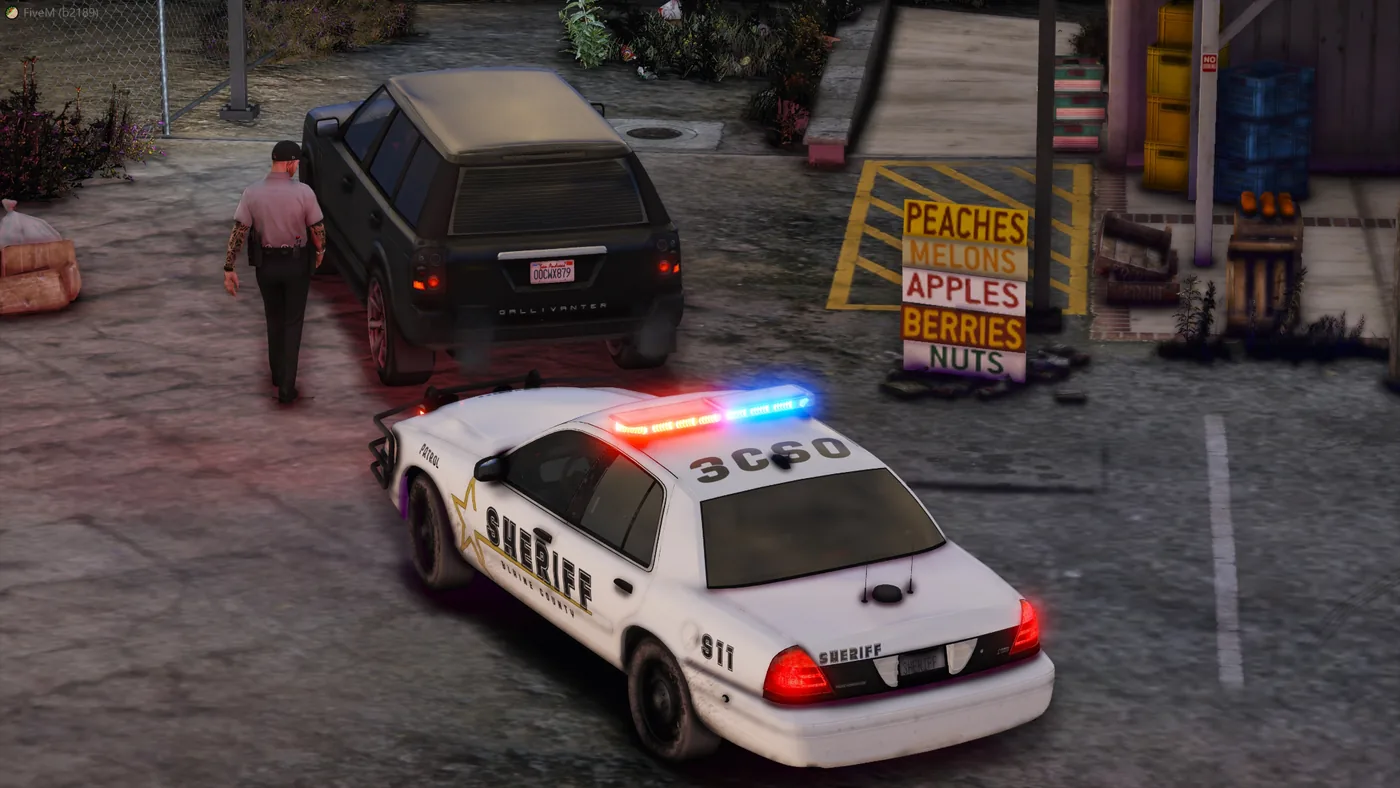
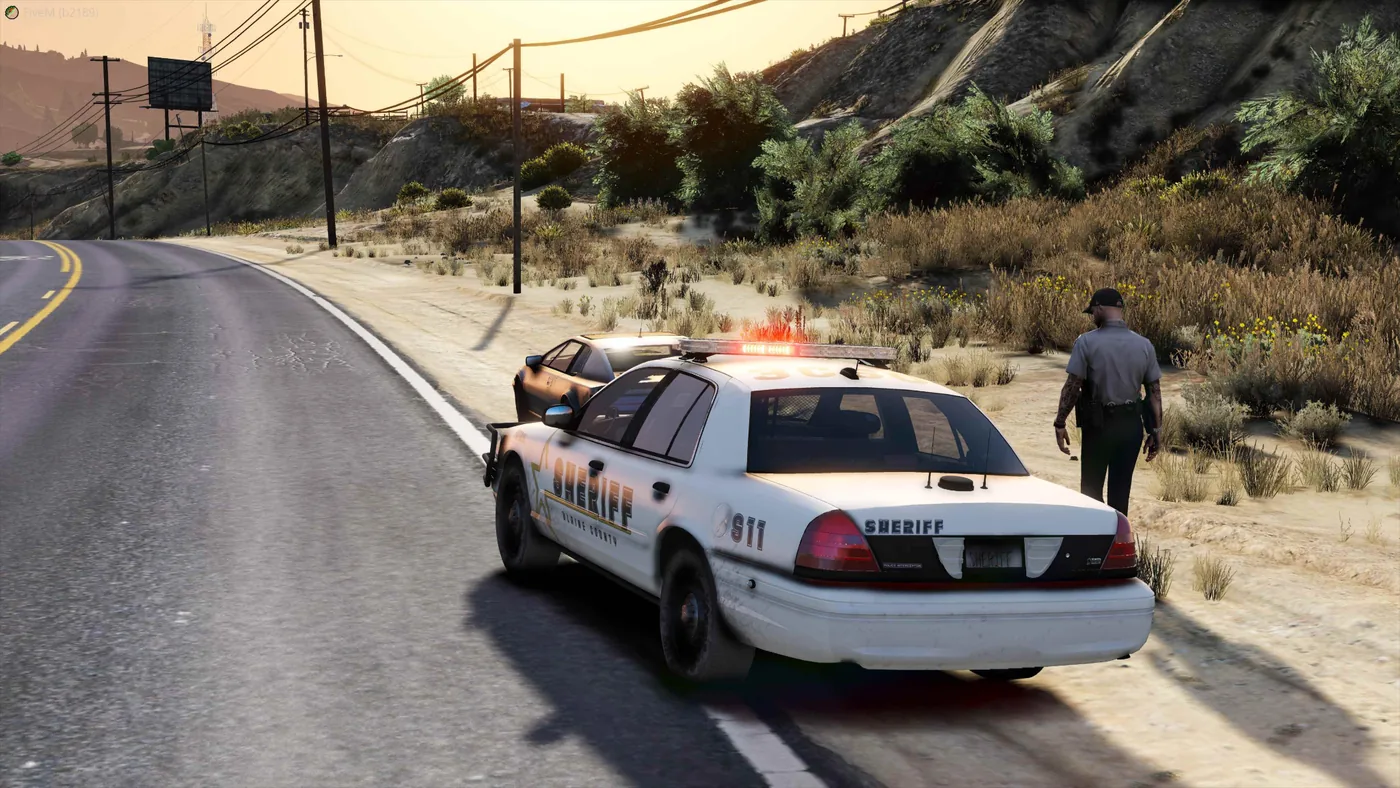
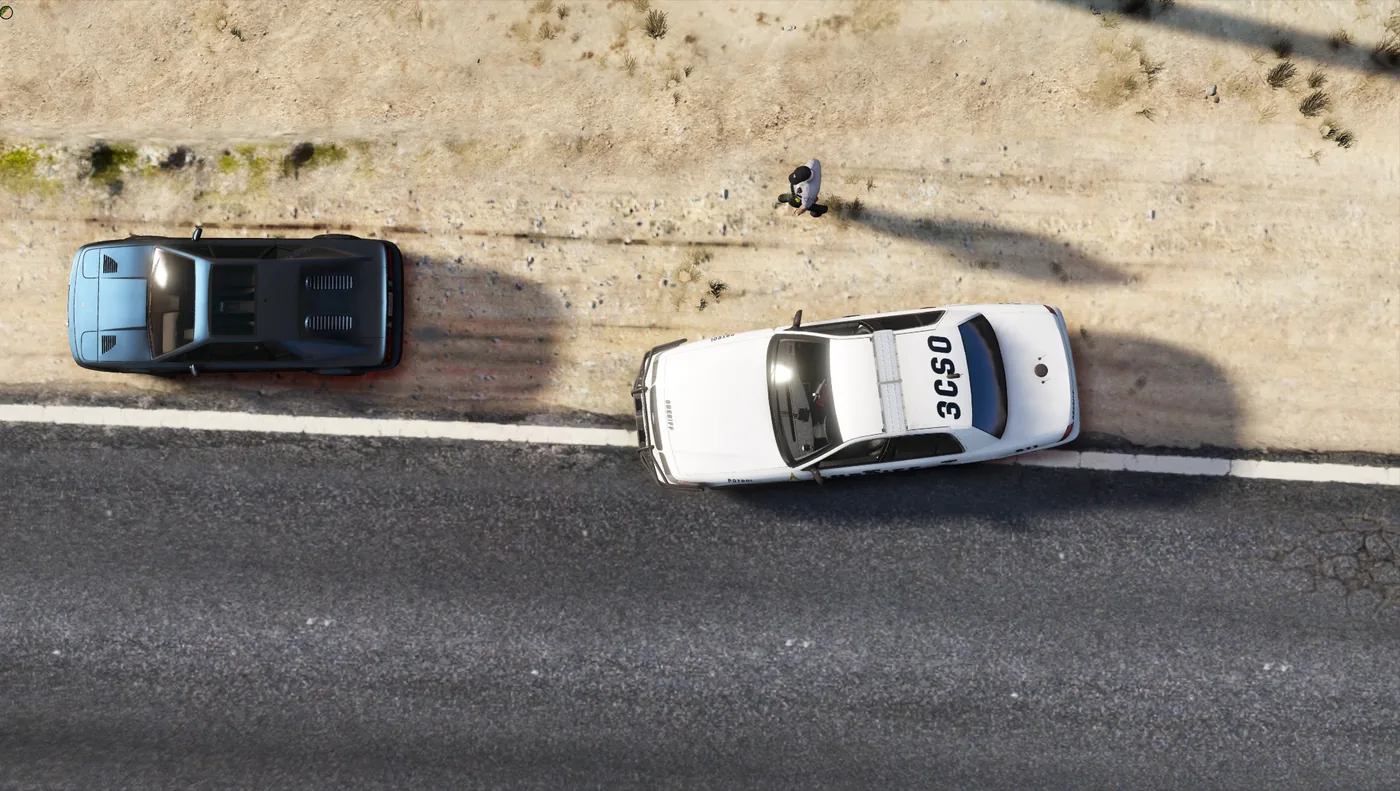
Prior to exiting their vehicle, Officers will alert dispatch (if active) of their traffic stop via proper radio procedures or through Computer Aided Dispatch ("CAD"). If there is no active dispatch, Officers must log the stop within CAD. Officers will include information pertinent to the stop such as:
- Street name
- Postal
- Description of vehicle (make, model, color)
- Number of occupants if known.
- The license plate of the vehicle
Once the vehicle an Officer is pulling over has successfully stopped, it is highly recommended that Officers run both the vehicle's license plate and the registered owner's information to verify the vehicle is not stolen, and that the registered owner has no warrants or prior convictions to cause concern.
511-03Approaching the Vehicle#
Officers will exit their vehicle in a safe manner ensuring there is no on-coming traffic. They will then approach the vehicle by either going around the backside of their vehicle and approaching the subject vehicle from the passenger side, or by approaching the subject's vehicle by the driver's side.
Upon making contact with the subject, Officers must identify themselves and state the reason for the traffic stop. Officers will then request the subject's driver's license, registration, and proof of insurance. Officers must remain vigilant throughout the entire interaction and stay alert to any unusual behavior, odd scents, and possible threats. Officers are highly encouraged to ask the subject if they have any weapons inside the vehicle. They are also highly encouraged to politely ask the subject not to reach for their weapons for both their safety and that of other law enforcement Officers on scene. After Officers have run the subject's information, they will return to the subject with a citation or a verbal/written warning. Officers are asked to communicate the traffic infraction to the subject with clarity prior to discharging them and request their signature on the bottom of the citation.
Throughout the entire traffic stop, Officers will conduct themselves in accordance with LSPD core values of integrity, excellence, fairness, and respect.
512High-Risk Traffic Stops (Code 5)#
"Code 5" stops are to be performed when it is deemed too dangerous to initiate a normal traffic stop. This is done when the registered owner has a felony warrant, the vehicle is reported stolen, the vehicle was involved in a dangerous crime, the vehicle has evaded police, or any other conditions that indicate a heightened threat to law enforcement Officers or other civilians
To ensure the safety of all law enforcement Officers involved on a felony stop, the following guidelines have been established:
- Officers shall advise dispatch that they will be initiating a code 5 stop followed by location, vehicle and occupant description. Officers shall request additionals if needed.
- Upon initiating a felony stop the patrol frequency must be held
- Exception: Patrol frequency shall not be held if the felony stop occurs within a TAC channel.
- To ensure the safety of all LEO involved, a minimum of 3 units is required for a felony stop to occur.
- The units shall set up on the road behind the suspect vehicle in the following order outlined in section 512-01 - Positioning.
- The suspect(s) shall be called back one at a time by the originating unit, preferably starting with the driver's side and then moving over to the passenger side.
- One at a time: Officers shall remove the first subject, call them back, and detain them before moving to the next suspect. The suspect must walk backwards to the sound of the Officer's voice. While a suspect is being moved towards law enforcement, the initiating Officer must have their weapon aimed at the suspect, while 1 of the additional law enforcement Officers must have their weapon aimed at the suspect vehicle and the other Officer covering the suspect.
- If the vehicle takes off for any reason, the primary unit shall also be the primary unit in the pursuit. If any subject(s) were already detained, other units shall remain on scene with the detained subjects, one unit for every detained individual if possible.
- After the felony stop has been completed, units shall clear the car fully approaching from the left side. After the vehicle is clear the Signal 100 shall be lifted.
512-01Positioning#
Safety is at the core of every felony stop and due to the highly dangerous subject inside. The department has 2 setups permitted.
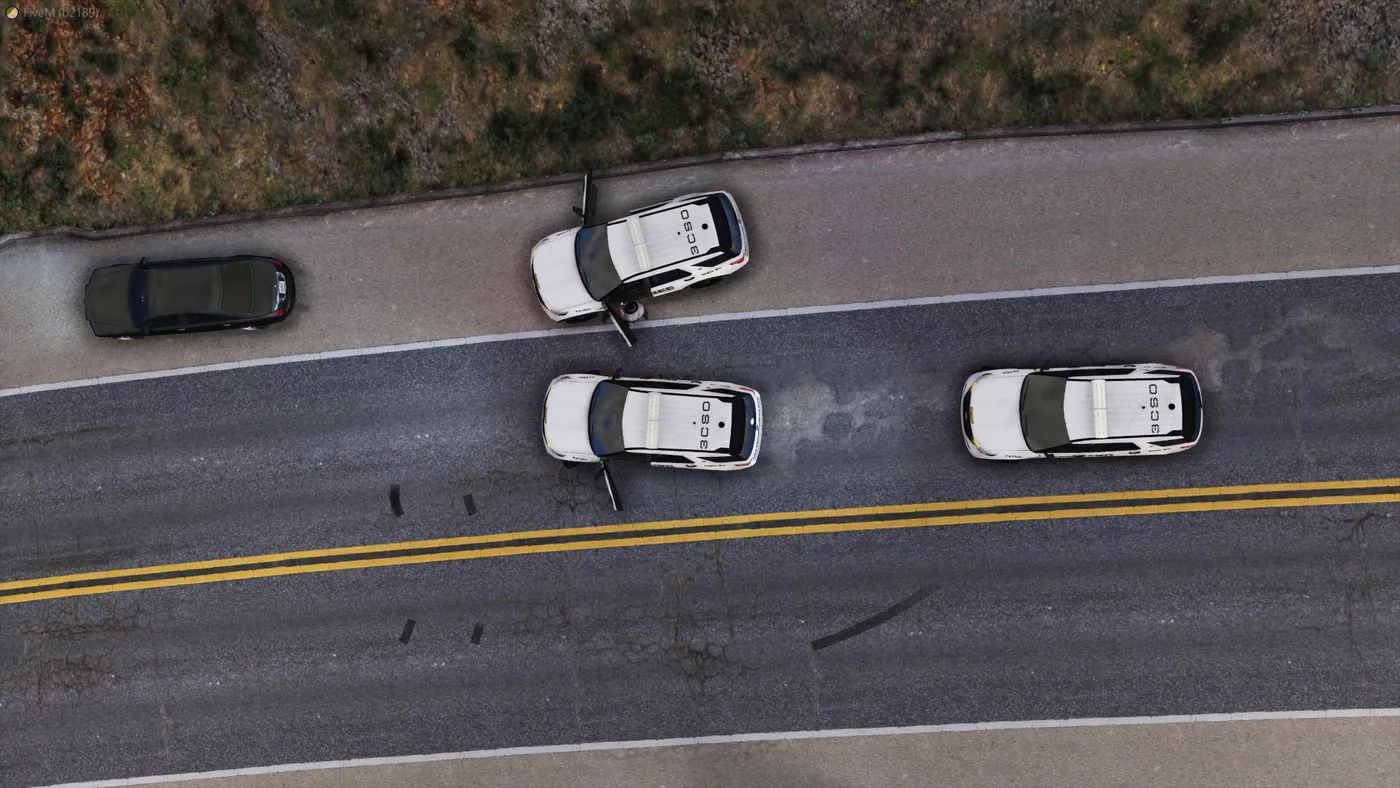
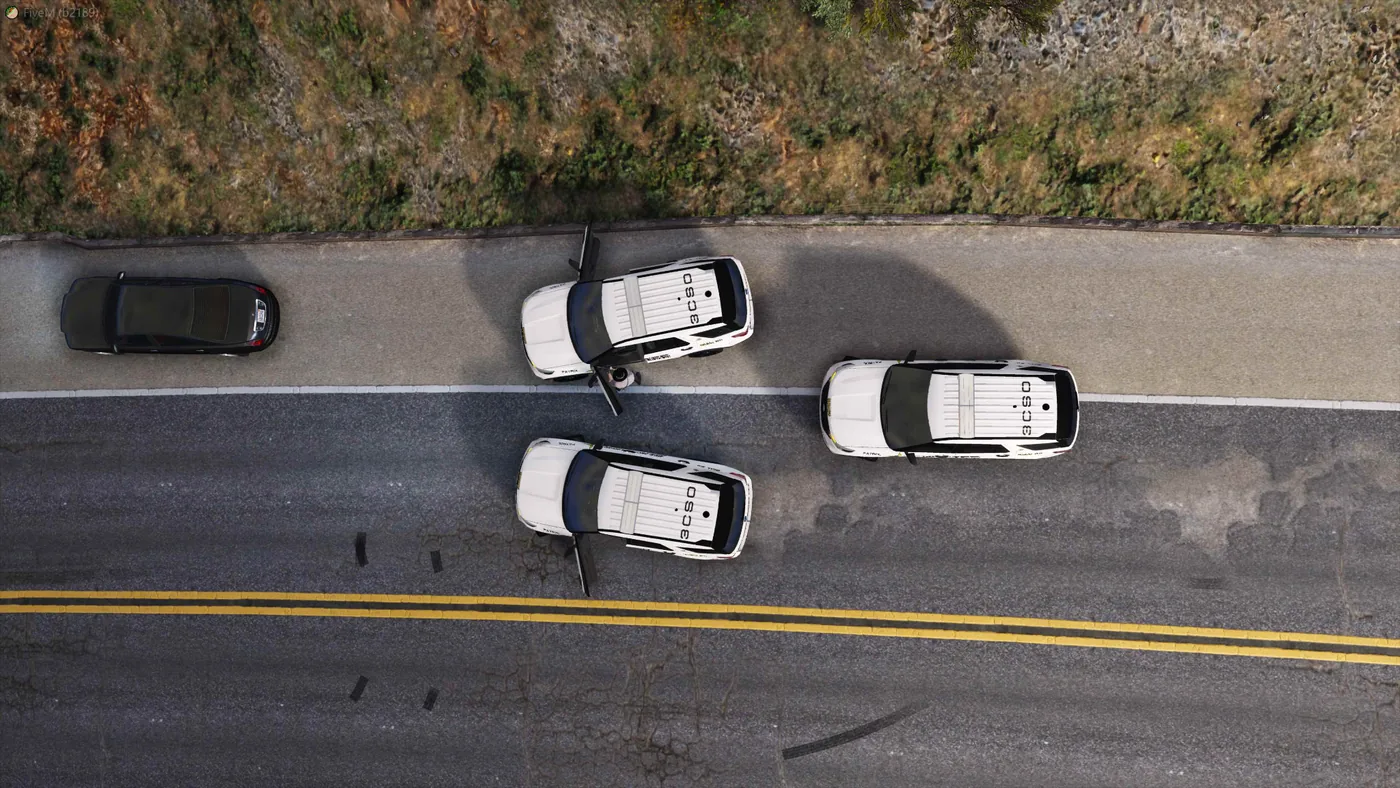
Whenever a road has more than 2 lanes (including the emergency lane) a third, fourth, etc cruiser may set up beside the cruiser closest to the middle of the roadway. The following restrictions apply:
- At all times no Officer will position their cruiser on a non-paved surface unless there is only 1 lane or no lane present.
- an Officer may never position their cruiser in oncoming lanes of traffic unless traffic is stopped by another unit in the opposite lane.
- All additional units which arrive on the scene will be set up behind the 3 primary units.
513Property Checks#
For the safety of the general public, Officers may conduct checks on local businesses when not responding to calls. This is not a requirement, though it is recommended to better serve the residents and visitors of San Andreas.
514When To Call A Supervisor#
Officers must call for a supervisor when:
- The Officer is unsure of what to do.
- A situation has escalated beyond control, where the Officer's safety, the safety of other LEOs, and the general public may be compromised.
- It is a priority
- An LEO is injured
- An LEO is involved in a Motor Vehicle Accident (Follow MVA Policy)
- an Officer discharges their firearm
- Any other situation deemed necessary by the Officer using best judgment.
When a supervisor arrives on scene, Officers must brief the supervisor on the situation as soon as possible. The supervisor will then advise the Officer on the best course of action. The initiating Officer may remain primary on scene unless deemed otherwise by the supervisor.
A supervisor may not abuse their authority to take over command of a scene when it is not warranted. A supervisor must make every effort to allow the Officer to continue their scene.
515Response Policy#
All Officers need to be aware of the response policy and follow it at all times. This will ensure safety for the civilians of San Andreas as well as the Officer's. Here are some response examples:
Code 1 calls:
- Parking Complaint
- MVA, no injuries, no road blockage and no smoke or fire present (Fender Bender)
- Loud Noise Complaint
- Shoplifting (Petty Theft)
- Trespassing (No weapons or confrontation)
- Public Intoxication (not putting themselves or others in danger)
- Traffic Stop Backup Request (subject doesn't have any warrants and isn't aggressive)
- Any call that ONLY requires report writing
- Any call where no one is in danger or being harmed
Code 2 calls:
- Report of an intoxicated driver
- Domestic Disturbance (Verbal)
- Traffic Stop Backup Request (Doesn't have warrants, but noncompliant)
- Road Hazard
- Any call not specified that requires a quicker response than routine, but no one is in immediate danger
Code 3 calls:
- Officer down
- Pursuit In Progress
- MVA with Injuries/roadblockage/fire or smoke/hanging off of a cliff, etc
- Medical calls that are life threatening
- Domestic Disturbance (Physical)
- Traffic Stop Backup (Subject has warrants and/or is combative)
- Structure Fire
- Kidnapping
- Terrorist Activity
- Any call not specified that requires an emergency response, and lives are possibly in danger
Special calls:
- Burglary in Progress and Hostage Situations - Respond Code 3, when in the area (5 blocks) drop down to Code 1.
When responding Code 2, Officers may NOT exceed 20 MPH over the posted speed limit. While responding Code 1, Officers may not break any traffic laws, or commit any traffic infractions.
516Scene Command Policy#
During a patrol, certain high risk scenes/situations may arise that require a higher level of organization and communication. During such situations, a Scene Commander must be established to ensure proper assignment of tasks, efficient communication with dispatch, and overall management of the scene. Scene Command is a title designated to the highest ranking LSPD member on a high-risk call assignment (If LSPD is the initiating/primary department and/or is within LSPD jurisdiction). Scene Command may request a tactical channel from Dispatch to avoid any unnecessary transmission over RTO and focus entirely on the scene at hand. Once Scene Command has been designated, it may only be turned over/taken over by a higher ranking member. Scene Command designation may not be abused by any members. Assuming Scene Command from other members, especially LSPD CoC members, must not be abused in order to give the opportunity for all Officers to display their leadership capabilities, gain confidence and experience.
Providing dispatch with timely and periodic status updates, requesting additional assets to the scene, and informing dispatch once the scene is complete is the responsibility of Scene Command.
517MVA (Motor Vehicle Accident) Policy#
Whether or not there are injuries present will determine the Officer's response code.
- Officers will respond Code 3 if injuries are present.
- Officers will respond Code 1 if there are no injuries and no vehicles blocking the road.
- Dispatch should automatically attach SAFR if injuries, entrapment, and/or other hazardous situations are present on the scene.
- If dispatch does not request SFD personnel or there is no dispatch, the responding Officer will assess the scene upon arrival and determine if:
- SAFR is needed on scene or if additionals are needed for traffic control
- If the MVA involves wildlife being struck, a GW unit must also be attached to the call.
Officers involved in a MVA:
Officers that are incapacitated and unable to access their radio:
- Officers must NOT press their panic button for a MVA.
- Officers will wait 10-20 minutes before messaging the dispatcher and requesting a 10-73 (Status Check).
- Officers may place a 911 call as a passing motorist (local) reporting the accident if reasonable to do so.
Officers that are not incapacitated and able to access their radio:
- Inform Dispatch they were involved in a MVA and request a supervisor. Officers will advise whether their self or any other persons were injured in the accident. Officers may also request that EMS is routed or staged. Officers must not delete their vehicle.
- All reports shall have have a crash diagram.
- Diagrams must illustrate the crash scene as closely, as reasonably possible.
- All reports shall document any applicate traffic control devices, road and weather conditions, skid marks, and debris.
- Officers shall document all probable contributing factors to the accident
- Officers shall document relevant statements provided by involved parties or witnesses along with vehicle damage.
- To include where the parties/vehicles were taken (released, towed, arrested, transported by EMS etc)
- Officers shall document the Traffic Unit in Error as "Traffic Unit 1"
- If deemed appropriate Officers should issue a citation(s) to the Traffic Unit in Error
- All Crash Reports shall have a narrative.
- The Narrative shall be used to document the above requirements if no other place on the crash report allows for that documentation along with any other facts that are reasonably necessary
518Arrest Procedures#
Officers may arrest a subject in the following situations:
- The Officer has an arrest warrant signed by a judge.
- The Officer observed an arrestable offense being committed.
- The Officer has probable cause to believe the suspect has committed a crime.
- The Officer believes that the suspect is unable to adquently care for themselves and need to be placed into protective custody.
To affect and arrest, Officers shall restrain the suspect in question. Officers are authorized to use force as long as proportional within the law and department policy to affect and arrest. Officers shall consult our use of force policy found under Section 600 - Introduction.
For Officer safety, Officers shall first equip the appropriate PPE before going hands-on with any suspect.
Upon gaining control of the suspect, Officers shall use the appropriate restraints approved and issued by this agency. Officers can also resort to the usage of a "spit hood" and or "hobble restraints" in case the subject is obstructive and resistive after handcuffs are applied.
Officers are required to ensure the handcuffs and or hobble restraints are secured and do not cause any form of pain.
Before the subject is placed into the back of a police cruiser or transferred to on-scene medics, the suspect must be properly searched. Officers shall ask the subject if he or she has any sharp objects on his person prior to the initiation of the search. Officers shall first equip the appropriate PPE.
Upon the completion of the search, Officers should carefully place the subject inside the police cruiser, securing the subject with a seatbelt. Officers are prohibited from assisting on any other call while having a suspect within their custody. Officers shall properly notify the active dispatcher that they are transporting a suspect to a jail facility, this is preferably done through the usage of the assigned CAD.
518-01Miranda Rights#
Law Enforcement Officers of all departments are required to read the Miranda Rights to any person that they plan on questioning after they have been detained. Failure to provide Miranda Rights may result in the dropping of proposed charges. The Miranda Rights are the following:
"You have the right to remain silent. Anything you say or do can and will be used against you in a court of law. You have the right to an attorney. If you cannot afford an attorney, one will be provided to you at no cost to you. Do you understand the rights I've just read to you? With these rights in mind, do you wish to speak to me without an attorney present?"
519Search Policy#
The Search Policy outlines every policy and or requirement when searching a suspect's person or property.
519-01Strip Searches#
1.1. Strip searches and visual body cavity searches, including anal or genital inspections, constitute reasonable searches under the Fourth Amendment when supported by probable cause and conducted in a reasonable manner.
1.2. The subject must only be strip searched in a police station behind closed doors out of view of any public that may be inside. In addition to this, an Officer of the same gender as the subject must complete the search. If one is not available, a "County Officer" may complete the search.
1.3 If a cavity search is being conducted Officers shall transport the suspect to the state prison or a nearby hospital. These searches may only be conducted by medical personnel.
519-03Fourth Amendment#
3.1. The Fourth Amendment of the U.S. Constitution provides that "the right of the people to be secure in their persons, houses, papers, and effects, against unreasonable searches and seizures, shall not be violated, and no warrants shall issue, but upon probable cause, supported by Oath or affirmation, and particularly describing the place to be searched, and the persons or things to be seized."
3.2. In general, most warrantless searches of private premises are prohibited under the Fourth Amendment, unless specific exception applies. For instance, a warrantless search may be lawful, if an Officer has asked and is given consent to search; if the search is incident to a lawful arrest; if there is probable cause to search and there is exigent circumstance calling for the warrantless search. Exigent circumstances exist in situations where people are in imminent danger, where evidence faces imminent destruction, or prior to a suspect's imminent escape.
3.3. Warrantless search and seizure of properties are not illegal if the objects being searched are in plain view. Further, warrantless seizure of abandoned property, or of properties on an open field do not violate Fourth Amendment, because it is considered that having an expectation of privacy right to an abandoned property or to properties on an open field is not reasonable.
3.4. The protection under the Fourth Amendment can be waived if one voluntarily consents to or does not object to evidence collected during a warrantless search or seizure.
519-04Definitions#
4.1 An unreasonable search and seizure is a search and seizure by a law enforcement Officer without a search warrant and without probable cause to believe that evidence of a crime is present.
4.2. Courts usually find probable cause when there is a reasonable basis for believing that a crime may have been committed (for an arrest) or when evidence of the crime is present in the place to be searched (for a search).
Search under Fourth Amendment occurs when a governmental employee or agent of the government violates an individual's reasonable expectation of privacy.
A dog-sniff inspection is invalid under the Fourth Amendment if the inspection violates a reasonable expectation of privacy or is not supported by reasonable suspicion. Electronic surveillance is also considered a search under the Fourth Amendment.
519-05Seizure of Property#
A seizure of property, within the meaning of the Fourth Amendment, occurs when there is some meaningful interference with an individual's possessory interests in the property.
In some circumstances, warrantless seizures of objects in plain view do not constitute seizures within the meaning of the Fourth Amendment. When executing a search warrant, an Officer might be able to seize contraband observed in plain view even if it is not specified in the warrant.
519-06Warrant Requirement#
A search or seizure is generally unreasonable and illegal without a warrant, subject to only a few exceptions.
To obtain a search warrant or arrest warrant, the law enforcement Officer must demonstrate probable cause that a search or seizure is justified. A court-authority, usually a magistrate, will consider the totality of circumstances to determine whether to issue the warrant.
The warrant requirement may be excused in exigent circumstances if an Officer has probable cause and obtaining a warrant is impractical in the particular situation. For instance, in State v. Helmbright, 990 N.E.2d 154, the Ohio court held that a warrantless search of a probationer's person or his place of residence is not a violation of the Fourth Amendment, if the Officer who conducts the search possesses "reasonable grounds" to believe that the probationer has failed to comply with the terms of his probation.
Other well-established exceptions to the warrant requirement include consensual searches, certain brief investigatory stops, searches incident to a valid arrest, and seizures of items in plain view.
There is no general exception to the Fourth Amendment warrant requirement in national security cases. Warrantless searches are generally not permitted in exclusively domestic security cases. In foreign security cases, court opinions might differ on whether to accept the foreign security exception to the warrant requirement generally and, if accepted, whether the exception should extend to both physical searches and to electronic surveillance.
520Booking Procedures#
Upon arresting any suspect, Officers must properly book the subject at a certified jail facility. Throughout the state of San Andreas, multiple booking locations are present.
Officers who arrest the suspect must book the suspect themselves and may not have other LEOs book the subject unless these LEOs know the extent of the incident.
Officers shall complete the following action during booking:
- Escort the suspect from cruiser to booking location.
- Officers shall complete an additional search if required.
- Officers shall properly document the suspect by taking a mugshot and fingerprinting.
- Whenever the equipment to complete step 3 is not present, Officers shall move over to step 4.
- Officers shall place the suspect in a cell and when locked, remove the cuffs that have been placed on the suspect.
- Officers shall write up the arrest report in accordance with the crimes committed.
- Officers shall jail the suspect for the crimes committed.
At no time should an Officer enter a cell by himself to interact with the suspect. At all times, there should be at least one additional Officer present.